
Bottom line:
• Embroidery ranges from basic running and satin stitches to complex machine-digitized designs used for logos and apparel.
• Fabric choice, stabilizer type, and stitch density affect how a finished design holds up to washing and wear.
• Local apparel decorators across Oakland County, MI rely on both hand and machine methods depending on the project.
Embroidery is the technique of stitching thread onto fabric to create decorative or branded designs, and beginners typically start with a handful of core stitches before moving to machine work. Understanding the basics helps explain why some designs last through years of washing while others fray or fade quickly.
Many people searching for embroidery services want to know how the process works before ordering custom apparel, whether for a sports team, a workplace uniform, or a personal gift. The craft has shifted significantly since its handmade origins, with computerized machines now handling most commercial-scale projects.
Beginners usually learn embroidery through a short list of foundational stitches before attempting anything decorative.
• Running stitch : a simple in-and-out pattern used for outlines and light detail work.
• Backstitch : a stronger, continuous line stitch often used for lettering.
• Satin stitch : tightly packed parallel stitches that fill in shapes with a smooth, glossy surface.
• French knot : a small raised dot used for texture, such as eyes on an animal design or accent details.
Each stitch serves a different visual and structural purpose, and most finished pieces combine two or three types rather than relying on one technique alone.
Machine Embroidery and Digitizing
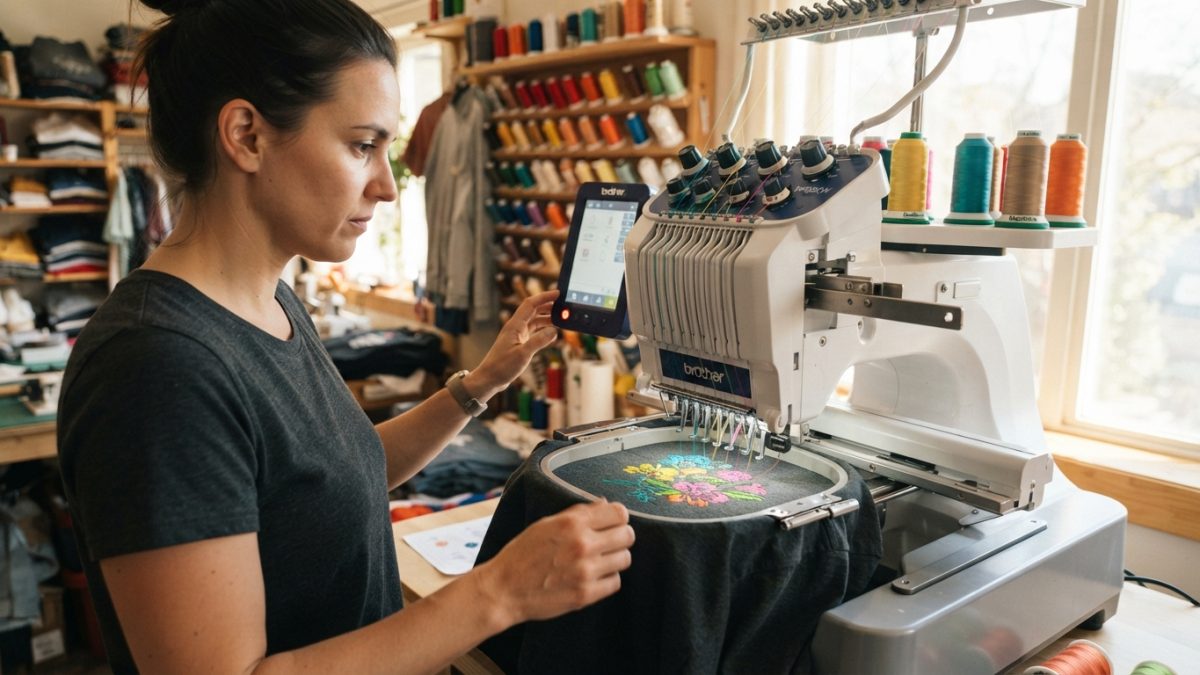
Commercial embroidery on shirts, jackets, and hats is almost always done by computerized embroidery machines rather than by hand, since machines can repeat a design with consistent tension and stitch count. Before a machine can sew a logo or design, it has to be converted into a digital stitch file through a process called digitizing, which maps out stitch direction, density, and sequence. According to the Smithsonian’s National Museum of American History, embroidery techniques have evolved from hand craft traditions into highly mechanized processes used widely in modern textile production.
Stabilizer backing is placed underneath the fabric during machine embroidery to prevent puckering and distortion, and the type used depends on the fabric weight:
| Fabric Type | Recommended Stabilizer | Typical Risk Without It |
| Lightweight knit (t-shirts) | Cutaway stabilizer | Puckering, stretched holes |
| Heavy twill (jackets, caps) | Tearaway stabilizer | Thread breakage, misalignment |
| Stretch fabric (performance wear) | Fusible mesh stabilizer | Design distortion after washing |
Choosing Thread, Fabric, and Design Density
Thread type affects both the look and durability of a finished design. Polyester thread resists fading and holds up well to repeated washing, while rayon thread offers a slightly glossier sheen but can be more delicate over time.
Stitch density, meaning how closely stitches are packed together, determines whether a design feels stiff or stays flexible on the garment. Overly dense stitching on thin fabric can cause puckering or tearing at the seams, which is why digitizers adjust density based on the base material before a design goes to production.
Design size also matters for legibility. Small text and fine detail often blur together when stitched too small, so designs intended for embroidery typically avoid very thin lines or tiny lettering that satin stitches cannot render cleanly.
Based in Novi, MI, custom apparel decorator Ink Tees Custom T-Shirts works with customers throughout Oakland County, MI on stitched and printed apparel projects.
What is the difference between hand and machine embroidery? Hand embroidery is stitched manually with a needle and thread, while machine embroidery uses a digitized file to automate stitch placement, allowing for faster and more consistent results on multiple garments.
Does embroidery last longer than printed designs? Stitched designs generally resist cracking, peeling, and fading better than many printed graphics, since the thread is woven into the fabric rather than sitting on its surface.
Can any fabric be embroidered? Most woven and knit fabrics can be embroidered with the correct stabilizer, though very thin or highly stretchy materials require extra care to avoid puckering or distortion.
How many stitches does a typical logo design use? Stitch count varies widely based on size and detail, with small logos often ranging from a few thousand stitches to tens of thousands for larger, denser designs.
A current list of service details for Ink Tees Custom T-Shirts is published for the local service area.